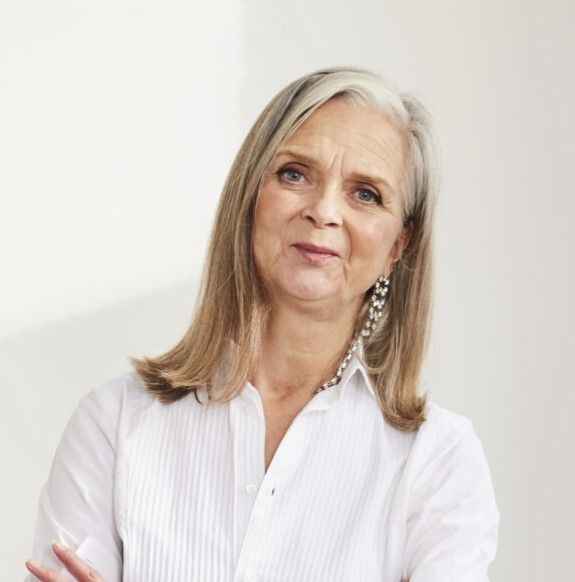
We interviewed Alyson Walsh, journalist and author of the popular ‘That’s Not My Age’ blog to understand her inspiration for age-positivity and championing ageless style.
You started your career in fashion working for some of the most established women’s magazines. Tell us about your experience and how that started to shape your area of interest?
As fashion editor at Good Housekeeping magazine (I was there for over seven years in the late 90s/ early noughties), it was important for readers to see relatable images on my pages.
The norm in the industry at that time was to feature women in their 30s, with life experience and womanly bodies, so this provided me with a grounding in age-positivity and encouraged me to push back against old-fashioned beauty standards.
Were there any specific defining moments in your early career that inspired you to focus on inspiring women of all ages to embrace ‘Ageless Style’?
I've worked in fashion through five decades, where beauty is diverse and ever-changing. When I was a fashion student in the 1980s, most of the catwalk shows, magazines and videos included a range of models. So that was what I saw growing up – it was only in the 1990s when we started to see very young and slim models. I’ve always believed that beauty isn’t just one thing - that diversity in terms of age, ethnicity and size is important.
When and why did you start your website, That’s Not My Age?
That’s Not My Age began in 2008 when I noticed a space online to celebrate midlife and beyond. The aim of TNMA has always been to kick invisibility into touch, and to celebrate and empower women of all ages. Sixteen years later, I am proud that as well as providing expert advice, style tips, interviews, and podcasts, That’s Not My Age has been at the forefront of a movement empowering women and calling out ageism and sexism.
Who else in the space do you admire?
I admire numerous women including Deborah Levy, Kristin Scott Thomas, Lesley Manville, Viola Davis, Tilda Swinton, Kirsty Wark, Linda Rodin, India Knight, Kay Montano, Lyn Slater, Daniela Gregis, Ellen Von Unwerth, Patti Smith, and Eileen Fisher.
You have written and published two books. Tell us about that process and are there any more in the pipeline?
My first book - 'Style Forever' - which was published in 2015 was an extension of the conversation on That's Not My Age. I wanted to delve deeper into the subject of age and prove that you don't have to have youth to have style. It was written in about two and a half months, on an incredibly tight deadline, but it’s a lifetime’s work and contains information, interviews and expert advice gathered from many years working in the fashion industry.My second book - 'Know Your Style' - published in 2017 talks less about age and more about style and dressing with confidence. It offers practical style advice on figuring out what makes you feel chic and comfortable, and covers everything from how to introduce more colour and print, to how to wake up workwear and pick and mix accessories. I gathered thoughts and style tips from women of substance who inspire me, including: Lucinda Chambers, Caroline Issa, Linda Rodin, Pat Cleveland, Sarah Jane Adams, Michelle Ogundehin, Lyn Slater and many more.
I have an idea for a third book in mind and it's something I've been thinking about for a while. The synopsis is written but I can't reveal anything yet – I promise that it will feature even more fantastic women in midlife and beyond. Watch this space!
At Wallacea Living you will interview some inspiring models and content creators on celebrating fashion for all ages. Tell us about some of the other many women you have interviewed on the topic who stand out in your memory for the way in which they embrace opportunities in later life?
Linda Rodin is a serial entrepreneur and founder of the independent denim label Linda Hopp. She lives in New York. On her boundless ideas and energy, she says, ‘My mother was always making things, taking art classes, had an antique shop, and was an interior decorator. So, I was surrounded by creativity my whole life. I love creating. If I’m not making something, I don’t know what to do with myself!’
I still can’t quite believe I interviewed the iconic Iris Apfel for my first book Style Forever. Now aged 102, the former interior designer has had a series of books, exhibitions and documentaries dedicated to her maximalist style. ‘I love museums and the arts, they’re very important to me,’ she told me over the phone, ‘I always try to stay current and be interested in things, otherwise you just dry up. You must get out there and get involved.’
One of the most popular models of the 1970s, Pat Cleveland appeared in the legendary catwalk show ‘The Battle of Versailles’ in Paris. She was a regular at nightclubs in Paris, and Studio 54 in New York, and still enjoys a night on the town. ‘I like to go out to an evening event and get dressed up. I want to have my eyelashes on, my heels and an evening dress because I think it’s important to have that kind of time. That night time with people is so different from the working day.’
What changes do you hope to see in fashion, whereby the industry becomes more inclusive?
For years we have been fed a very narrow view of what is beautiful. Things are changing. Increased democracy, social media and the sheer size of the older demographic has disrupted the fashion industry and it's now much more commonplace to see older faces in the media. But change has been slow, and we do need to keep pushing.
There has been an improvement in inclusivity and diversity over the last decade but it can still feel tokenistic. It’s almost as if some brands are just ticking off a to-do list rather than making fundamental change – for example using older models in their campaigns but not featuring them on their websites and so on.
We need to see more people represented: more women in their 50s-and-beyond, more shapes, sizes, ethnicities and abilities portrayed realistically by the media. This reduces stereotyping and allows us to see the beauty in ourselves. When we get to the point when a more inclusive representation is the norm, then I think we will have achieved something.
Can you share your top tips on how to find your own personal style in later life?
Style is not dictated by trends; it’s not about spending money and it's certainly not about age. Understanding what works for you – from the shades that suit your complexion and the silhouettes that suit your body shape to identifying the clothes that bring you joy – takes commitment and flexibility. Set aside some time to do a wardrobe MOT, experiment with different looks and reconsider old favourites. Play around with pattern, print, texture, silhouettes and colour until something clicks. Style is a work in progress and putting together winning outfits gets easier the more you continue to mix, match and experiment.